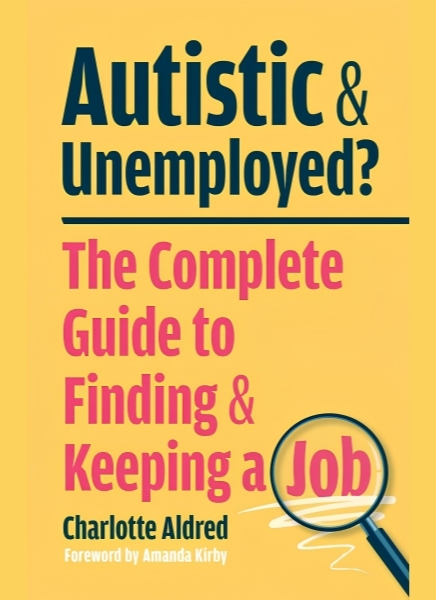
Are you autistic and unemployed? Do you have trouble finding or keeping a job? Then this book, which is addressed directly to you, whether diagnosed or not, regardless of your interests, nationality, ethnic background, talents or skills, gender, location and the type of work you want, may be just what you are looking for. Although this book is written primarily for autistic people, many of the recommendations are likely to be helpful to other neurodivergent jobseekers. The book may also be really useful to anyone, whether family or professional, who is trying to help a neurodivergent person find long-lasting and rewarding work. This book will be published by Jessica Kingsley Publishers on October 21st 2026 and is currently available to pre-order.
‘In the UK, only 3 in 10 autistic people are in employment. With this worrying statistic in mind, ‘Dr Charlotte Aldred’s new book is incredibly welcome and timely… This book will be equally helpful to parents and guardians of autistic children, like myself, who find the experiences of other parents so valuable as we seek to give our child the best chance in life. We all know that autistic people have so many skills and talents to offer employers, and this book is an important tool in helping to unlock that potential.’ The Rt Hon Sir Robert Buckland KBE KC MP, Chair of the All Party Parliamentary Groups on Autism and Learning Disability, leader of the autism employment review and father of an autistic adult.
Chapter Headings
Stage 1: Getting Started
1 – How this Book is Structured
2 – Sources of Support
3 – Identify your Strengths and Skills
4 – Sharing your Autism Identification
Stage 2: Overcoming Workplace Barriers
5 – Qualifications and Work Records
6 – Social and Communication
7 – Sensory
8 – Executive Functioning and Processing Speed
9 – Stress and Anxiety
10 – Transport and Housing
11 – Motor Skills
Stage 3: Looking for Work
12 – Self-employment and Employment
Appendix: Interview Checklist
References
Why is this book needed?
The employment situation of autistic people is shocking, with approximately 70-80% unemployed, even in countries where awareness of autism is high ( Buckland 2024; United Nations 2015).Not only do many autistic people find it difficult to obtain and maintain employment, however intelligent or well educated they are, they also
When 985 neurodivergent employees were asked how likely it was that they would leave their current organization within the next 12 months, over 40% said they were likely or very likely to leave (McDowall, Doyle and Kiseleva 2023). Support from the line manager, psychological safety and career satisfaction were the most significant factors predicting whether a neurodivergent employee was likely to stay in their role McDowall, Doyle and Kiseleva. Nearly 23%, of the nearly 1000 neurodivergent individuals from several countries, were thinking of quitting their job because their employers didn’t support their needs sufficiently while more than a quarter have left their job in the past for the same reason (Alludo 2025). If you are autistic, these statistics may not come as a surprise to you – nor will their consequences. We know that autistic people seek social engagement and community – something a job can provide. Without employment the risk is that autistic people find themselves isolated, lonely and unhappy as well as financially dependent on others. If you have applied for many jobs without success or been unable to keep a job for any length of time, your self esteem is likely to be badly affected, leaving you feeling unfulfilled and worthless. This highly stressful situation may lead to feelings of anxiety, depression and anger.
The impact on society of not employing those autistic people that are capable of working is quite significant, both in terms of the financial cost to the taxpayer and in terms of the loss of competitive advantage to the businesses that don’t make use of their talents. Enabling more people to work is good for the economy with an increase in tax receipts and personal spending power and a reduction in the amount spent on income support benefits, day support programmes and medical services (Social Market Foundation 2021; Hedley, Hedley and Shiell 2022).
Why is the employment situation for autistic people so bad?
The chief barrier to the successful employment of autistic and other neurodivergent people is the lack of awareness, knowledge, understanding and acceptance of these conditions by employers, managers and staff at all levels (All Party Parliamentary Group on Autism 2019). Prejudice, discrimination and stereotyping all play their part, even if subconsciously. For example, 29% of the 2241 neurodivergent employees participating in the Autistica survey (2024) have experienced discrimination in the workplace due to their neurodivergence. This can lead to inappropriate recruitment processes, an unwillingness to provide suitable workplace accommodations and a culture of bullying.
Organizations can be wary of employing people who think or learn differently and they may be unsure how to integrate them successfully into their workforce. Not knowing where to go to for help or advice, they can worry about getting support wrong for an autistic employee (National Autistic Society 2016) and some fear that disabled people will claim discrimination if the job does not work out and will then take them to an employment tribunal. Governments, as well as employers, are responsible for the autism employment gap. They are generally unwilling to put sufficient resources into improving the employment situation of autistic people despite the fact that, in the long-term, their employment would be financially beneficial to the state. In both the UK and the US specialist employment support is characterized by under-funding, leading to poor wage levels, high staff turnover, low availability and uneven training Bernick and Vismara 2021) The period between school/college and employment involves a shift from the structured and hopefully supportive environment of education to one that involves the free-for-all of the competitive employment market, a transition most autistic young people would find extremely difficult to manage in the absence of sufficient support. In addition, only 19% of young autistic people say they have had good careers advice (Ambitious about Autism 2016) and with insufficient work experience this has resulted in many graduating from university and college with no notion of what to expect from work (National Autistic Society 2009).
Who is this book written for?
Are you autistic (formally identified or self-identified)? Are you having trouble finding or keeping a job? Then if you wish to work, this book is addressed directly to you, regardless of your interests, nationality, ethnic background, talents or skills, gender, location and the type of work you want. As well as encouraging you to exploit your strengths, skills and talents, this book helps you to find ways around any workplace barriers and has the potential to lead to a long and satisfying work life.
This book should also be really useful to anyone, whether family or professional (including special educational staff, careers advisors at school, college and university, autism charities, job coaches, mentors and staff at UK Jobcentres), who is trying to help an autistic person find work. Many careers advisors, for example, don’t know enough about neurodivergence in order to tailor their guidance effectively to the person they are trying to help. Autistic people often need a considerable amount of assistance if they are to find long-lasting and satisfying careers in a world designed for non-autistic individuals.
Although this book is written primarily for autistic people, many of the recommendations are likely to be helpful to other neurodivergent jobseekers if they are having difficulties finding or keeping a job. This is particularly true given that co-occurrence of neurodivergent conditions (such as ADHD and autism) is the norm.
[Neurodiversity is an umbrella term which refers to the natural variations in the way people think and process information: co-occurrence is common. It encompasses many cognitive identifications including autism, attention deficit (hyperactivity) disorder (ADD/ADHD), developmental language disorders, dyscalculia, dysgraphia, dyslexia, dyspraxia/developmental coordination disorder (DCD), nonverbal learning disability, obsessive compulsive disorder (OCD), specific language impairment and tic disorders including Tourettes.]
How you might like to read this book
I would suggest that if you are an autistic person trying to find a job, you read this book a bit at a time as it is quite detailed. It would be sensible to read Chapters 1-4, then pick out from Chapters 5 to 11 whichever chapters you think would be most useful and finally finish with Chapter 12. There is a certain amount of repetition in the book, partly because certain parts are so important they are worth repeating but also because you may not read all the chapters and may miss something valuable if it is not repeated. One piece of advice that is echoed constantly throughout this book is that, whenever you find anything hard to understand or carry out, get help from a trusted and knowledgeable person. I appreciate this may be easier if you have someone trying to support you already but what should you do if you have no-one? There are quite a few charities or not-for-profit organizations that aim to help autistic people and I would suggest that you contact them and see if they know of anyone who might be willing to help you.
Language
I have used identity-first language throughout this book, that is autistic person rather than person with autism, as this is the preference of most autistic people (Bonnello 2022).>Although I have tried to use neuro-affirming language throughout this book, many of the chapters contain checklists which may look judgemental. I hope the autistic reader won’t> find these checklists offensive. The checklists are there to help you understand how a non-autistic employer might see you and highlight those differences that might be causing you to have difficulties finding or keeping a job. In most countries alterations to your workplace which help you to carry out a better job are described as workplace accommodations whereas the UK uses the word adjustments. I have usually used the word accommodations.
This book could not be more timely or more necessary. Across the world, autistic people remain excluded from work at shocking rates—despite their intelligence, creativity and persistence. Work is about far more than income; it is a route to belonging, purpose and identity. Yet for too many, the door remains closed, or only partially open.
Dr Charlotte Aldred’s book is rooted in both lived family experience and deep professional understanding. It does not simply outline the problems—it provides practical steps and strategies to make change possible. What stands out is the balance between realism and hope. There is no minimising of the barriers: poorly designed recruitment systems, lack of awareness among employers, and the cumulative impact of rejection on self-esteem and mental health. But alongside this honesty sits an empowering framework. Readers are guided to understand their strengths, anticipate potential challenges, and identify the adjustments that can make work both possible and sustainable.
This book is written with autistic jobseekers in mind, but its wisdom reaches further. Families, careers advisors, job coaches and employers will all find in these pages a resource that challenges assumptions and points to solutions. It reminds us that employment is not about fixing people to fit rigid systems, but about adapting environments to unlock talent.
The strength of this book lies in its clarity and practicality. It recognises co-occurrence of conditions, it speaks in accessible language, and it keeps the focus on achievable actions. At a time when inclusion can too easily be reduced to rhetoric, this book provides a roadmap for genuine change.
I commend this book to you warmly. It has the potential to transform not only individual lives but also workplaces and communities, enabling more people to thrive, contribute and belong.
Prof Amanda Kirby